
BPC-157 vs GHK-Cu
Los dos aparecen en modelos de matriz y angiogénesis, pero describen procesos distintos. BPC-157 es un pentadecapéptido de origen gástrico asociado a señalización angiogénica preclínica. GHK-Cu es un tripéptido que fija cobre(II) y se estudia sobre matriz extracelular.
| Especificación | 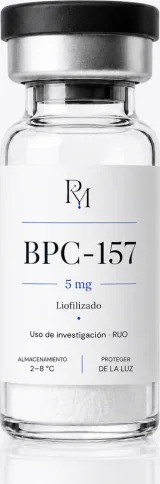 BPC-157 BPC-157 | 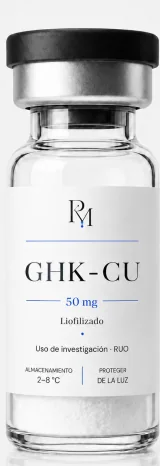 GHK-Cu GHK-Cu |
|---|---|---|
| Mecanismo | Péptido gástrico estable | Tripéptido de cobre |
| Código | — | — |
| Fórmula molecular | C62H98N16O22 | C14H22CuN6O4 |
| Masa molar | 1419.55 Da | 401.91 Da |
| Pureza | ≥99% | ≥99% |
| Presentaciones | 5 mg | 50 mg / 100 mg |
| Precio | desde $580 MXN | desde $499 MXN |
| Área | Regeneración de tejido | Matriz extracelular |
| Evidencia | BPC-157 | GHK-Cu |
|---|---|---|
| Estado | En catálogo (RUO) | En catálogo (RUO) |
| Nivel de evidencia | C | C |
| Estudio clave | Chang CH (2011) | Freedman JH (1982) |
Nivel de evidencia: A revisiones o ensayos en humanos replicados · B ensayo humano temprano · C estudios en animales · D in vitro o mecanismo. Referencias primarias indexadas en PubMed; contexto de investigación, sin implicar uso humano.
Diferencia principal entre BPC-157 y GHK-Cu
BPC-157 se estudia en modelos de formación de vasos. GHK-Cu se estudia sobre componentes de la matriz y transporte de cobre a la célula. Coinciden en algunos sistemas experimentales, pero no comparten mecanismo.
Criterios de comparación de BPC-157 y GHK-Cu
La tabla separa identidad molecular, mecanismo, masa molar, evidencia publicada, presentaciones y disponibilidad. Una coincidencia en el área de investigación no vuelve equivalentes dos compuestos: secuencia, receptor, modelo experimental y documentación del lote se revisan por separado.
Uso exclusivo de investigación (RUO). No apto para consumo humano o animal.
Comparativas relacionadas con BPC-157 y GHK-Cu
Referencias de BPC-157 y GHK-Cu
- Chang CH, Tsai WC, Lin MS, Hsu YH, Pang JH (2011). The promoting effect of pentadecapeptide BPC 157 on tendon healing involves tendon outgrowth, cell survival, and cell migration. J Appl Physiol. doi:10.1152/japplphysiol.00945.2010
- Hsieh MJ, Liu HT, Wang CN, et al. (2017). Therapeutic potential of pro-angiogenic BPC157 is associated with VEGFR2 activation and up-regulation. J Mol Med (Berl). doi:10.1007/s00109-016-1488-y
- Seiwerth S, Milavic M, Vukojevic J, et al. (2021). Stable Gastric Pentadecapeptide BPC 157 and Wound Healing. Front Pharmacol. doi:10.3389/fphar.2021.627533
- Bajramagic S, Sever M, Rasic F, et al. (2024). Stable Gastric Pentadecapeptide BPC 157 and Intestinal Anastomoses Therapy in Rats — A Review. Pharmaceuticals (Basel). doi:10.3390/ph17081081
- Matek D, Matek I, Staresinic E, et al. (2025). Stable Gastric Pentadecapeptide BPC 157 as Therapy After Surgical Detachment of the Quadriceps Muscle from Its Attachments for Muscle-to-Bone Reattachment in Rats. Pharmaceutics. doi:10.3390/pharmaceutics17010119
- McGuire FP, Martinez R, Lenz A, Skinner L, Cushman DM (2025). Regeneration or Risk? A Narrative Review of BPC-157 for Musculoskeletal Healing. Curr Rev Musculoskelet Med. doi:10.1007/s12178-025-09990-7
- He Y, Jin Y, Wang X, et al. (2022). Pharmacokinetics, distribution, metabolism, and excretion of body-protective compound 157, a potential drug for treating various wounds, in rats and dogs. Front Pharmacol. doi:10.3389/fphar.2022.1026182
- Demirtaş H, Özer A, Yıldırım AK, et al. (2025). Protective Effects of BPC 157 on Liver, Kidney, and Lung Distant Organ Damage in Rats with Experimental Lower-Extremity Ischemia-Reperfusion Injury. Medicina (Kaunas). doi:10.3390/medicina61020291
- Lee E, Burgess K. (2025). Safety of Intravenous Infusion of BPC157 in Humans: A Pilot Study. Altern Ther Health Med. doi:PMID:40131143
- Freedman JH, Pickart L, Weinstein B, Mims WB, Peisach J (1982). Structure of the Glycyl-L-histidyl-L-lysine—copper(II) complex in solution. Biochemistry. doi:10.1021/bi00262a004
- Maquart FX, Pickart L, Laurent M, Gillery P, Monboisse JC, Borel JP (1988). Stimulation of collagen synthesis in fibroblast cultures by the tripeptide-copper complex glycyl-L-histidyl-L-lysine-Cu2+. FEBS Lett. doi:10.1016/0014-5793(88)80509-X
- Siméon A, Emonard H, Hornebeck W, Maquart FX (2000). The tripeptide-copper complex glycyl-L-histidyl-L-lysine-Cu2+ stimulates matrix metalloproteinase-2 expression by fibroblast cultures. Life Sci. doi:10.1016/S0024-3205(00)00803-1
- Min JH, Sarlus H, Harris RA (2024). Glycyl-L-histidyl-L-lysine prevents copper- and zinc-induced protein aggregation and central nervous system cell death in vitro. Metallomics. doi:10.1093/mtomcs/mfae019
- Jiang F, Wu Y, Liu Z, Hong M, Huang Y (2023). Synergy of GHK-Cu and hyaluronic acid on collagen IV upregulation via fibroblast and ex-vivo skin tests. J Cosmet Dermatol. doi:10.1111/jocd.15763
- Zhang Q, Liu J, Deng MM, Tong R, Hou G (2023). Relief of ovalbumin-induced airway remodeling by the glycyl-L-histidyl-L-lysine-Cu(2+) tripeptide complex via activation of SIRT1 in airway epithelial cells. Biomed Pharmacother. doi:10.1016/j.biopha.2023.114936
- Mehr A, Henneberg F, Chari A, Görlich D (2020). The copper(II)-binding tripeptide GHK, a valuable crystallization and phasing tag for macromolecular crystallography. Acta Crystallogr D Struct Biol. doi:10.1107/S2059798320013741
- Bian Y, Deng M, Liu J, et al. (2024). The glycyl-L-histidyl-L-lysine-Cu2+ tripeptide complex attenuates lung inflammation and fibrosis in silicosis by targeting peroxiredoxin 6. Redox Biol. doi:10.1016/j.redox.2024.103237
- Mao S, Huang J, Li J, et al. (2025). Exploring the beneficial effects of GHK-Cu on an experimental model of colitis and the underlying mechanisms. Front Pharmacol. doi:10.3389/fphar.2025.1551843
- Miller TR, Wagner JD, Baack BR, Eisbach KJ (2006). Effects of topical copper tripeptide complex on CO2 laser-resurfaced skin. Arch Facial Plast Surg. doi:10.1001/archfaci.8.4.252
- Mokhtar J, Mohamad B, Haddad J, Said A, Menon A, et al. (2026). The Regenerative Potential of GHK-Cu in Aesthetic Medicine. Aesthet Surg J. doi:10.1093/asj/sjag169
- Tewari K, Liu TP, Im C, Hamad C, Petrigliano F, et al. (2026). Peptide Supplements and Their Therapeutic Applications in Sports Medicine. Am J Sports Med. doi:10.1177/03635465261464420
- Jeon S, Maeng J, Lee J, Kim YM, Nam G (2026). Extract-GHK-Cu Complex Attenuates Th2 Cytokines and Promotes Keratinocyte Recovery. Antioxidants (Basel). doi:10.3390/antiox15070818
Literatura primaria indexada en PubMed. Referencias de contexto de investigación; no implican uso clínico ni humano.